International Schools in Asia: School Counts and Growth by Country
Asia is home to 58% of the world’s international schools. See school counts and growth trends for China, India, Japan, Vietnam, and Thailand, plus Korea’s English-medium schools.

Eve NamGrowth Marketer
Did you know that more than half of the world's international schools are in Asia?
Asia has a large number of international schools, but growth varies widely from country to country.
Looking at how many English-medium schools each country has, and where that number is rising, reveals how education markets across Asia are changing.
In this article, we first explain what counts as an international school, then look at school counts and recent growth in major Asian countries, along with the current picture in Korea, using publicly available data. It may also serve as a starting point for parents considering an international school or teachers preparing to work at one abroad.
What counts as an international school?
Different organizations count international schools in different ways. This article follows the definition used by ISC Research, a firm that studies the international schools market. It counts a school as international if it teaches all or part of a preschool to high school curriculum in English in a country where English is not the main language. Under this definition, foreign schools that teach in Japanese or French are excluded, while private schools that teach in English are included even if most of their students are local.
58% of the world's international schools are in Asia
According to ISC Research's 2025 count, there are 15,075 English-medium international schools worldwide. They enroll about 7.6 million students and generate $69.3 billion in annual tuition income. About 40% of these schools belong to school groups that run multiple campuses.
The five countries with the most international schools are China, India, the United Arab Emirates (UAE), Pakistan, and Indonesia, all of them in Asia. ISC Research classifies Middle Eastern countries such as the UAE as part of West Asia.
Source: Tes, "International sector passes 15,000 school milestone" (September 2025)
By region, 58% of the world's international schools are in Asia. This article focuses on East, Southeast, and South Asia.
Source: ICEF Monitor, "Continuing expansion of K-12 international school sector" (February 2026)
International schools by country
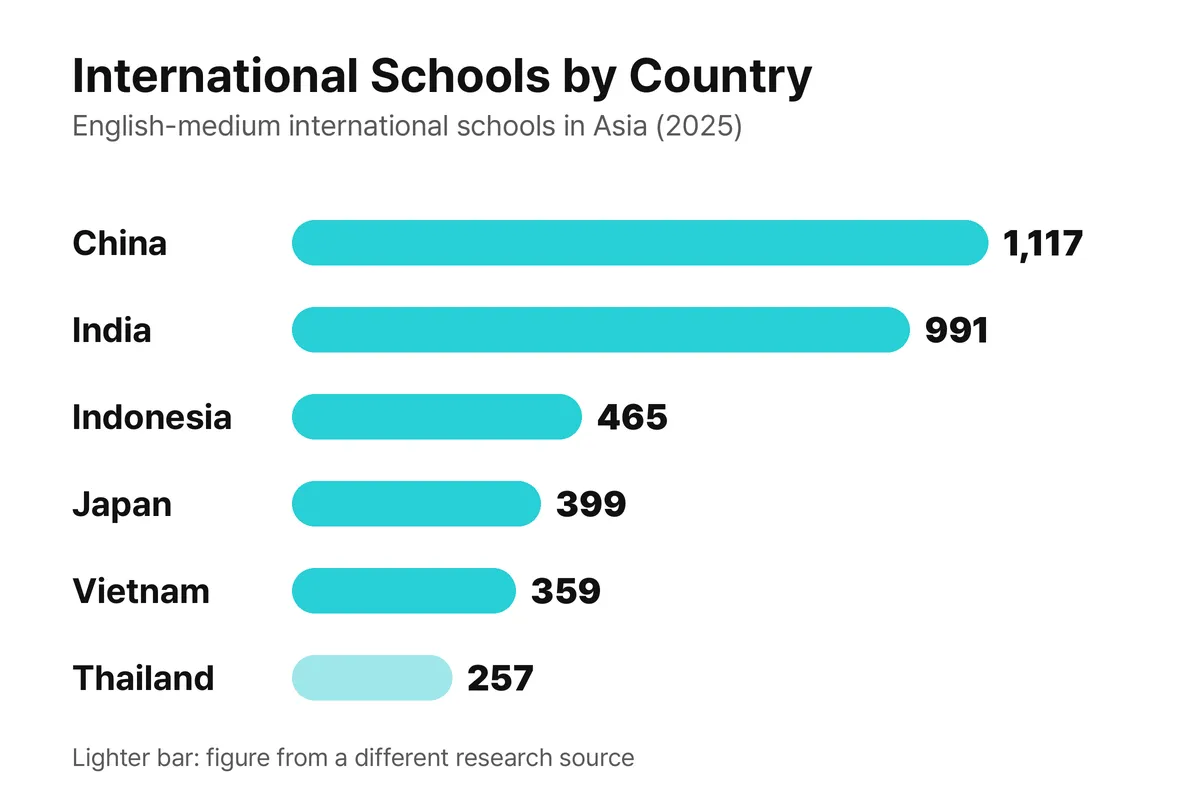
Country | International schools | Source |
|---|---|---|
China | 1,117 | ISC Research, 2025 |
India | 991 | ISC Research, 2025 |
Indonesia | 465 | ISC Research, 2025 |
Japan | 399 | ISC Research, 2025 |
Vietnam | 359 | ISC Research, 2025 |
Thailand | 257 | Kasikorn Research Center, 2025 |
Because ISC Research has not published a public figure for Thailand, we used the count from Thailand's Kasikorn Research Center. Since the sources and definitions differ, direct comparisons between countries have limits.
Sources: Tes (September 2025), Tes (April 2025), ICEF Monitor (May 2025), The Nation (May 2025)
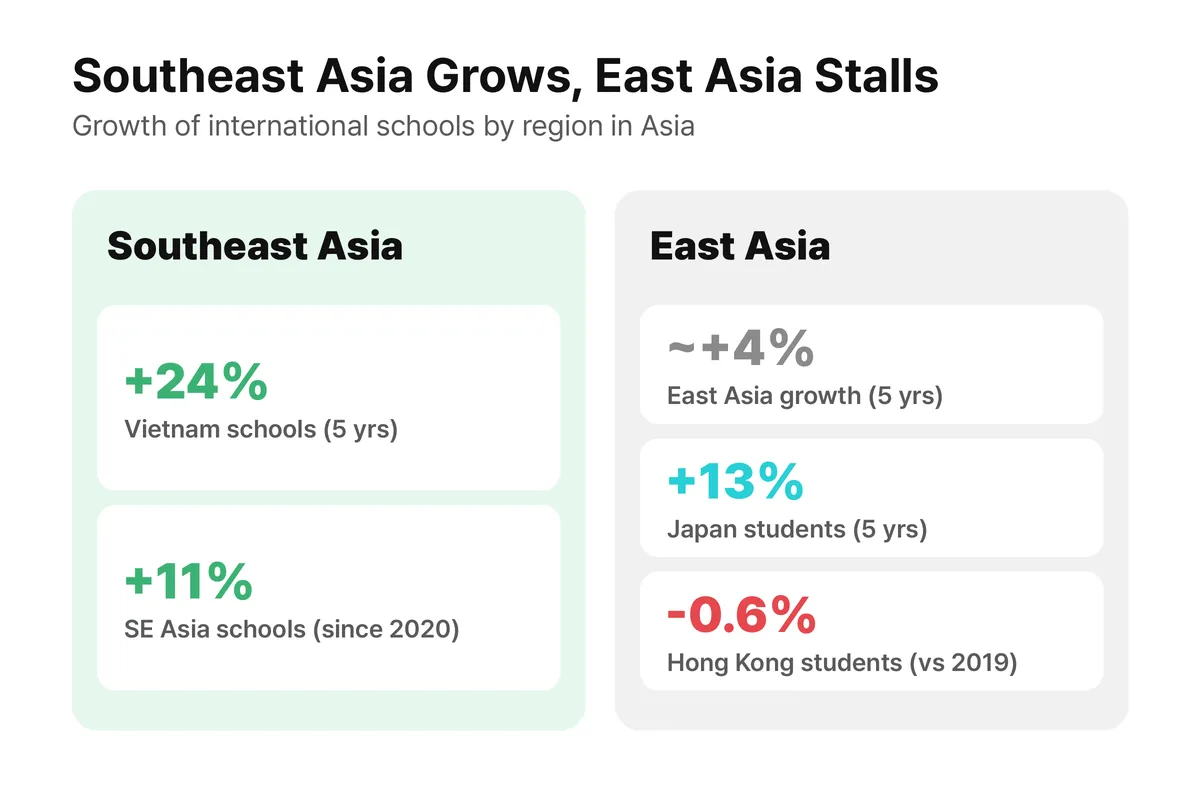
Southeast Asia grows, East Asia stalls
Even within Asia, the trends are quite different.
Vietnam and Southeast Asia
The number of international schools in Vietnam grew 24% over the past five years, making it one of the growth markets ISC Research highlighted. Southeast Asia as a whole has grown 11% since 2020, slightly ahead of other regions along with West Asia.
Source: ICEF Monitor (May 2025)
Thailand
In Thailand, total student numbers were projected to fall 1.1%, while international school enrollment was projected to rise 8.3%. Even as the school-age population shrinks, more families are choosing international schools. In 2023, revenue at 20 leading international schools reached 7.33 billion baht, up 28% from the year before.
Sources: Kasikorn Research Center (February 2025), The Nation (May 2025)
India and Indonesia
With 991 schools, India ranks second in Asia, and its school count still grew 2% in the past year. Indonesia, with 465 schools, ranks fifth in the world and is one of the fast-growing markets ISC Research has named.
Source: ICEF Monitor (February 2026)
Japan
Japan is a country of steady growth in East Asia. Over five years, its number of schools rose from 372 to 399, and enrollment grew from 72,500 to 81,660 students. Over the same period, staff numbers rose 18%, from 7,408 to 8,720. Well-known overseas schools are also expanding into Japan, including a leading British school opening a campus in Kobe.
Sources: Tes (April 2025), ISC Research (October 2024)
China and Hong Kong
East Asia as a whole grew only about 4% over the past five years, below the global average. China still has the most international schools in Asia, but its school count has barely grown since 2021, and 22 planned schools have made no progress. In Hong Kong, enrollment is down 0.6% from 2019. Because international schools there are generally expected to have foreign passport holders make up 70% of their students, a decline in expatriate families directly affects enrollment.
Source: ISC Research, "East Asia's Stalling International Schools Market" (October 2024)
International schools and foreign schools in Korea
In Korea, tuition-charging schools that teach in English fall into two main types: international schools and foreign schools. International schools are established under laws for Free Economic Zones and Jeju Special Self-Governing Province, while foreign schools are established for the children of foreign families living in Korea.
7 international schools
There are seven international schools in Jeju Global Education City and Korea's Free Economic Zones.
Four are in Jeju: Korea International School Jeju (KIS), North London Collegiate School Jeju (NLCS), Branksome Hall Asia (BHA), and St. Johnsbury Academy Jeju (SJA). The other three are in Songdo and Daegu.
As of 2025, the four Jeju schools enrolled 4,144 students, about 72% of their capacity, and a fifth school is scheduled to open in August 2028.
Sources: Official disclosures from Jeju Global Education City and Korea's Free Economic Zones, Seoul Shinmun (April 28, 2026)
37 foreign schools, 21 of them English-medium
There are 37 foreign schools licensed by Korea's Ministry of Education.
Of these, 21 teach in English, and the other 16 are Chinese, Japanese, German, French, and Mongolian schools.
Source: Korea Ministry of Education, Status of Foreign Schools (2025)
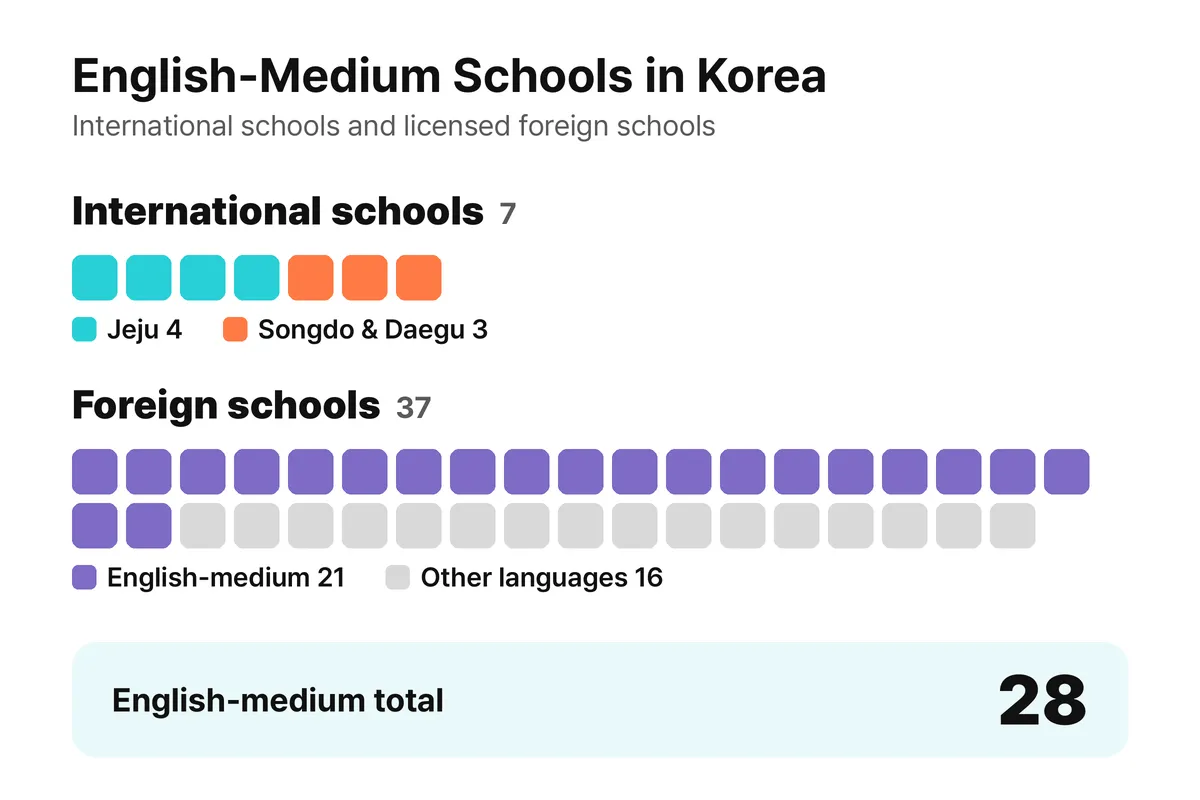
Together, Korea has 28 tuition-charging schools that teach in English. That is small compared with China or Japan, but a new international school is being prepared in Jeju.
What to keep in mind when reading the numbers
Numbers depend on the definition: The Hong Kong government counts 53 international schools for the 2025/26 school year, including schools that follow Japanese, Korean, French, and German curricula. That is a broader scope than ISC Research, which counts only English-medium schools.
Look at schools and students separately: Even if the number of schools rises, the overall market may not grow if each school enrolls fewer students. Hong Kong, where enrollment is declining, is a clear example.
Public figures come from different years: Data by country ranges from 2024 to 2026, so it's best to check each organization's latest release for current numbers.
Source: Brand Hong Kong, International Education (June 2026)
Summary
Asia is the center of the world's international school sector. China and India have the most schools, while Southeast Asia, led by Vietnam, is growing fastest. In East Asia, Japan continues to grow steadily, while China and Hong Kong have stalled. In Korea, there are seven international schools and 21 English-medium foreign schools.
At English-medium schools, students learn not only math and science but also life subjects such as financial literacy in English.
To see how to bring financial literacy into an English class, read our guide to financial literacy in English class.
Katsby creates English financial and economic education for upper elementary and middle school students.
This blog is run by Katsby, which creates English financial and economic education for teens.