Financial Literacy in English Class: 3 Activities for Elementary Students
How to bring financial literacy into elementary English class: six simple money words, three ready-to-use activities, a 40-minute lesson flow, and tips by English level.

Haru ParkHead of Growth & Partnerships
When are students most engaged in English class? Usually not when they read sentences from a textbook, but when they talk in English about things connected to their own lives.
Finance is exactly that kind of topic.
Allowance, snacks, saving, and things they want to buy: everyday experiences for elementary students are all connected to financial concepts. In this article, we look at why teaching English and financial literacy together works so well, which money expressions suit elementary learners, and three activities you can use in class right away.
Why teach English and financial literacy together?
Teaching subject content and a foreign language together is called CLIL (Content and Language Integrated Learning). A Cambridge University Press introduction to CLIL describes it as "an approach that combines the teaching of academic content with the learning of a foreign or second language."
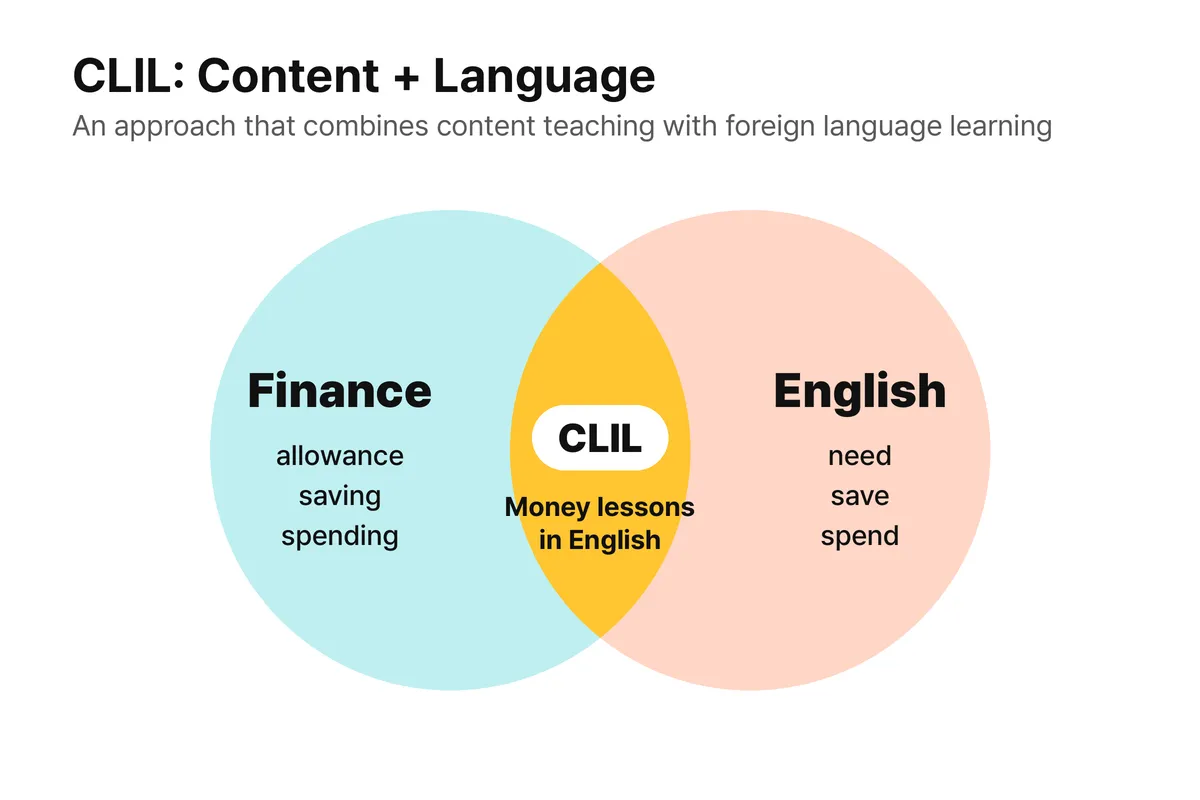
Financial literacy is a particularly good fit for this approach.
The words are concrete. Money words like save, spend, and price mostly refer to actions and objects students can see, so even elementary students can understand them through pictures and situations.
Students have something to say. "What do you want to buy?" and "Why did you choose it?" have no right answer, so every student can share their own story, whatever their English level.
English materials are plentiful. As we saw in our article on the U.S. financial education mandate, the U.S. is expanding financial education into the regular curriculum, and public agencies have shared many free English-language lesson materials.
Financial vocabulary for elementary learners
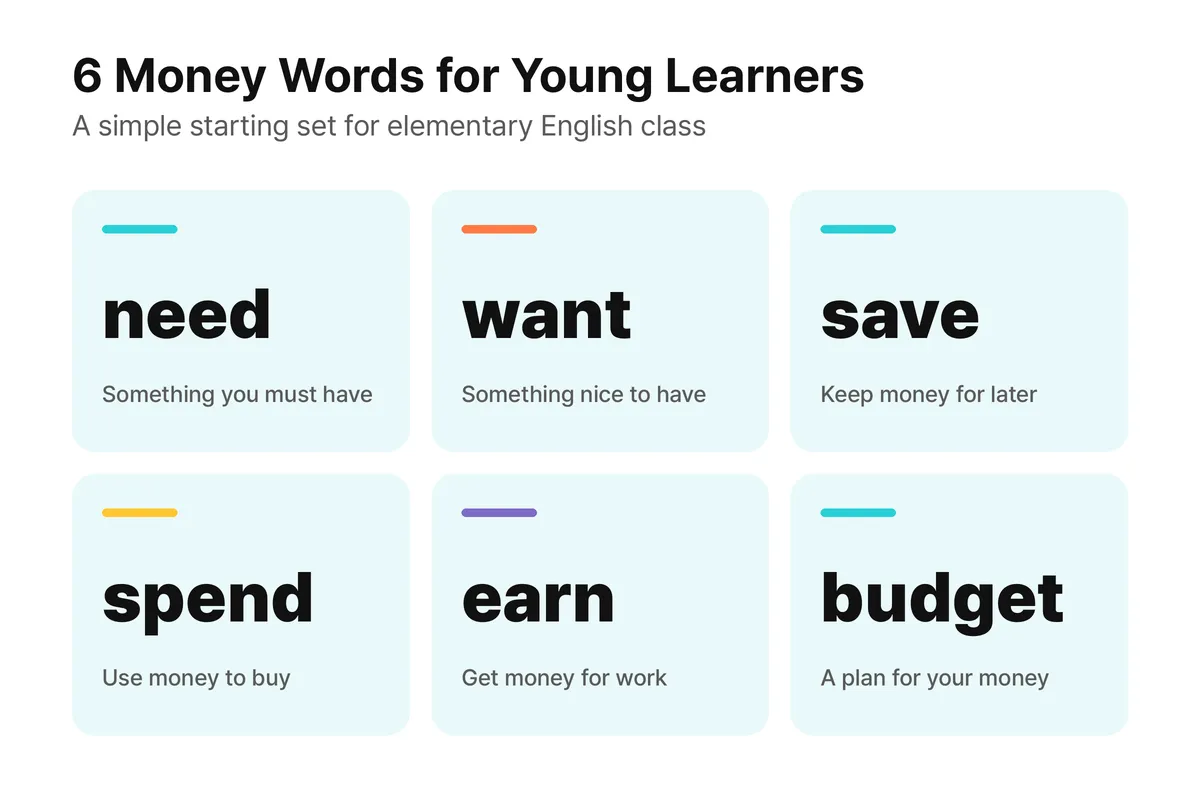
These six words are enough to start. Rather than having students memorize the words alone, give them sentence frames they can fill in with their own stories.
Word | Meaning | Sample sentence |
|---|---|---|
need | something you must have | I need a notebook for school. |
want | something you would like to have | I want a new game. |
save | to keep money for later | I save 1,000 won every week. |
spend | to use money to buy something | I spent 1,500 won on snacks. |
earn | to get money for doing something | I earn money by helping at home. |
budget | a plan for how to use your money | My budget for this week is 5,000 won. |
3 financial literacy activities for English class
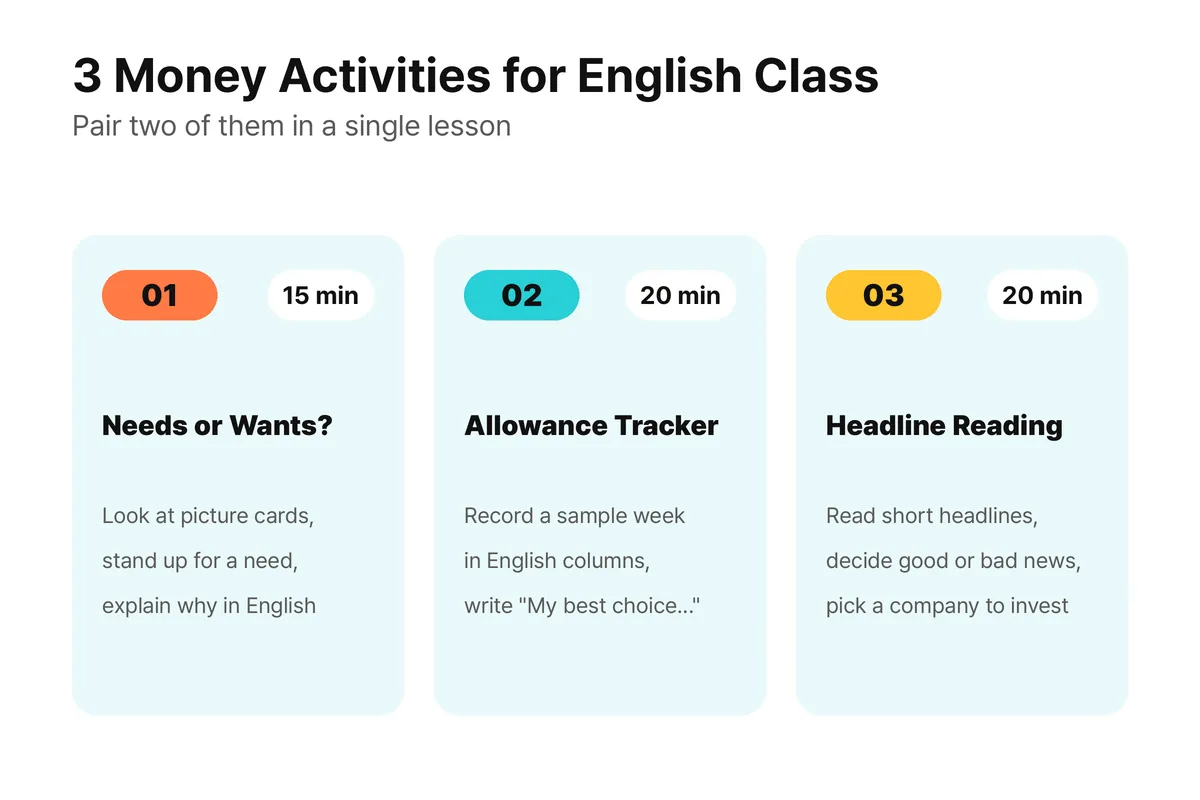
Activity 1. Needs or Wants? Stand-up game (15 min)
The teacher shows picture cards of items one at a time (a backpack, candy, water, a toy, and so on). Students stand up if they think the item is a need and stay seated if they think it's a want. Asking a few students to explain with "I think it's a need because..." naturally turns the game into a speaking activity. Emphasizing that answers can differ from person to person makes the discussion livelier.
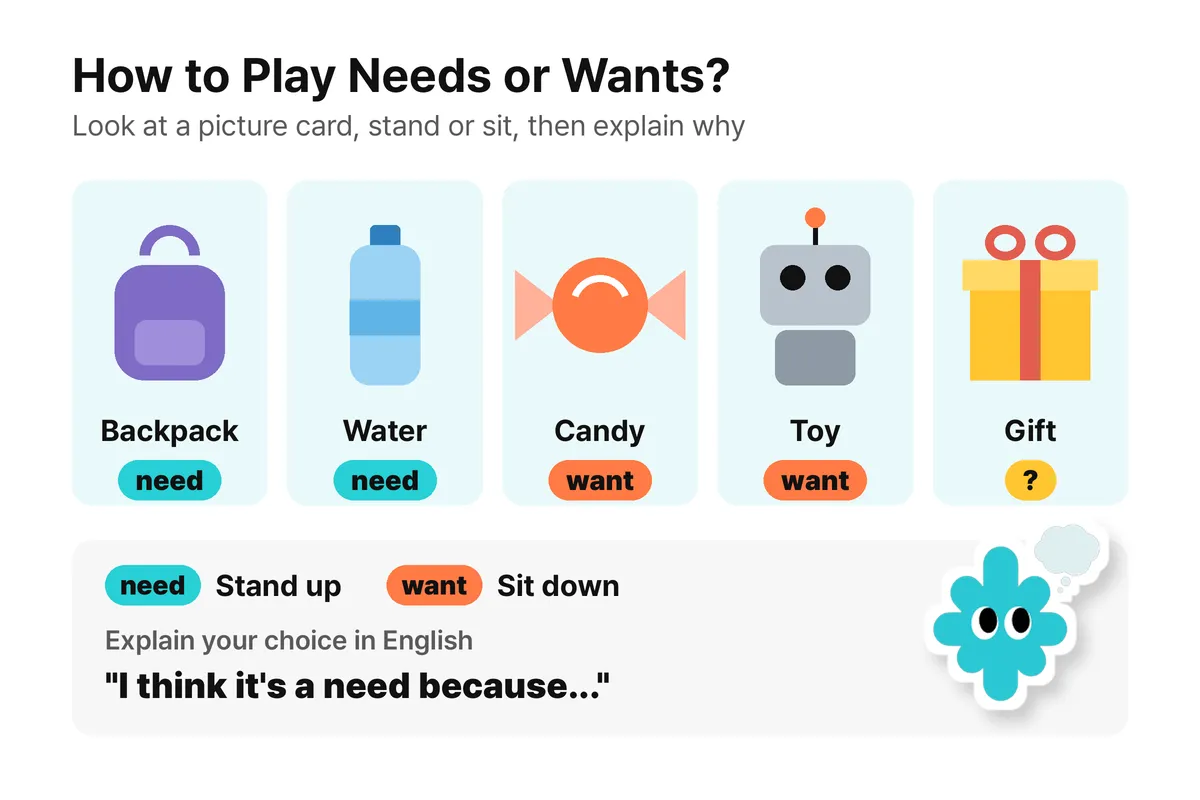
The U.S. Consumer Financial Protection Bureau (CFPB) also offers a free "Need or Want" game in the same format as a lesson for kindergarten to grade 1 (ages 5 to 7). Because it's written in English, you can refer to it directly in English class. (Link)
Activity 2. English allowance tracker (20 min)
Run the allowance tracker activity from our allowance tracker article in English. Students copy the expenses from a sample scenario into the Date, What, Money in, Money out, and Balance columns, then reflect by finishing the sentence "My best choice this week was..." It's also a chance to practice reading and writing numbers in English.
Activity 3. Read headlines and pick a company (20 min)
Show several short English headlines, such as "Ice cream sales rise in hot summer" and "Toy company opens new store," and have each team choose which company they'd like to invest in. Deciding whether a headline is good or bad news for the company lets students practice reading comprehension and economic thinking at the same time. Expanding this activity over several lessons turns it into the mock investing class from our mock investing class article.
Sample 40-minute lesson flow
Rather than fitting all three activities into one class, pairing two in a single lesson works best. If you're just getting started, try this structure.
Time | Activity |
|---|---|
5 min | Introduce today's words: need, want, save, spend |
15 min | Needs or Wants? stand-up game |
15 min | Record a sample scenario's expenses in the English allowance tracker |
5 min | Each student shares a sentence: "My best choice was..." |
In the next lesson, add earn and budget and move on to the headline reading activity. This lets you build a short financial literacy unit of about three lessons in English.
Adjusting by English level
Beginner: Focus on words and picture cards, and let students know it's fine to explain their reasons in Korean.
Basic: Write a sentence frame such as "I need ___ because ___." on the board, and have students fill in only the blanks.
Advanced: Have students read a short paragraph from an English article and write two or three sentences about how the news might affect the company.
What to watch out for
Don't turn it into a vocabulary test: The goal isn't memorizing money words, but the experience of explaining your own choices in English.
Understanding comes first: For students who find English difficult, it's fine to check the concept in Korean first and then move on to the English expression.
Clarify the currency: English materials often use dollars, so either stick to won in class or explain the unit clearly at the start.
Wrap-up
When you connect English class with financial education, students use English on topics close to their real lives and understand financial concepts more deeply by putting their thoughts into English. Without preparing new materials, you can start in your next English class with just picture cards, an allowance tracker, and a few short headlines. Teaching financial literacy in English isn't about giving up one subject for the other. It's a lesson where each subject becomes material for the other.
Katsby creates English financial and economic education for upper elementary and middle school students. You can download the free English allowance tracker worksheet from our allowance tracker article.
This blog is run by Katsby, which creates English financial and economic education for teens.