How to Run a Classroom Economy: 5 Steps for Elementary Teachers
What is a classroom economy, and does it work? A 5-step guide for elementary teachers, from choosing a currency to jobs, taxes, saving, and a class market.

Jasmine LeeHead of Curriculum & Learning
How to Run a Classroom Economy: 5 Steps for Elementary Teachers
What if students could earn a salary, pay taxes, and even save and invest, all inside the classroom? Running a classroom economy makes that possible.
In a classroom economy, students experience economic life firsthand using a currency that exists only in the classroom. Because it lets students revisit the money concepts from their textbooks in everyday classroom life throughout the school year, it has become a staple of hands-on elementary financial education. In this article, we cover what a classroom economy is, what research has found about it, a five-step setup for first-time classrooms, and what to watch out for.
What is a classroom economy?
A classroom economy is an activity that turns the classroom into a small society with its own currency. Students take on class jobs to earn a salary, then use it to pay taxes, buy items or coupons, and save or invest what's left.
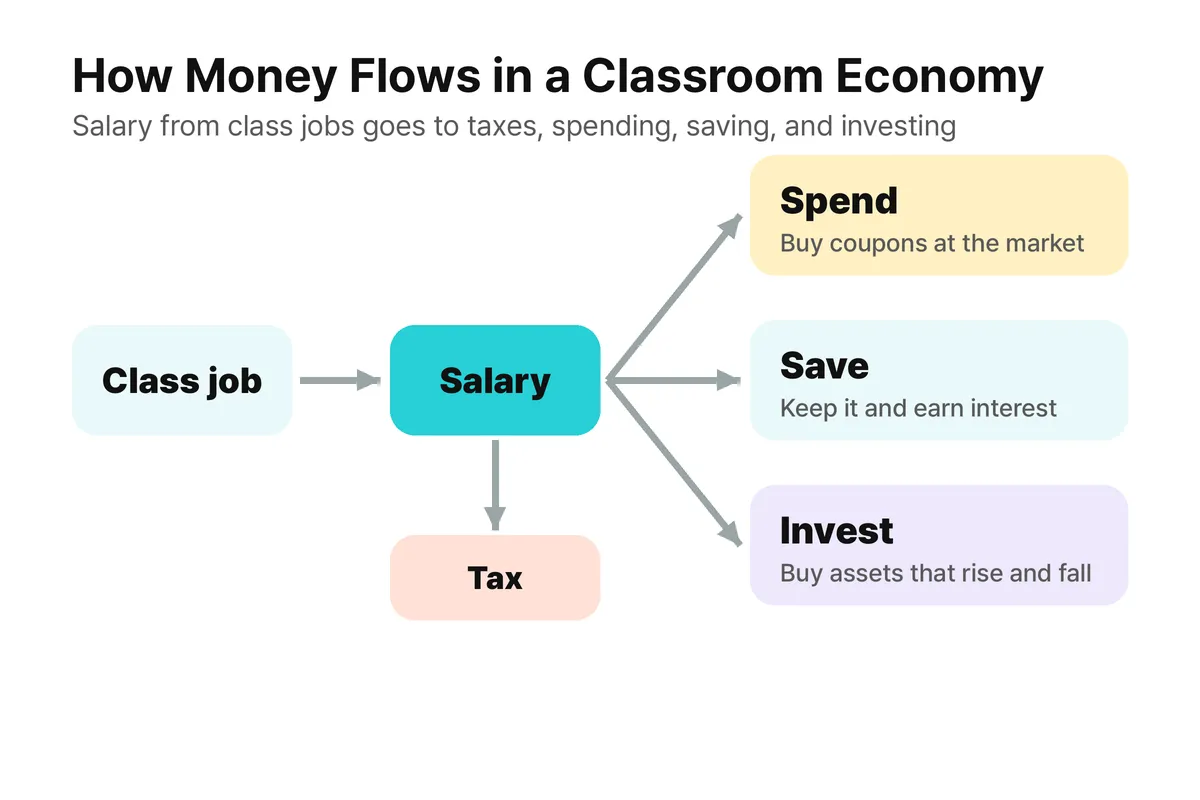
In Korea, interest grew after an elementary school teacher in Busan became known for an economics class run on a classroom currency. Each month, students choose a job based on their strengths and its pay, then pay income tax, health insurance, and an electricity bill out of their salary before receiving their take-home pay.
Does a classroom economy work?
In the U.S., the asset management company Vanguard offers a free classroom economy program called My Classroom Economy. An evaluation funded by the U.S. Department of the Treasury compared about 2,000 students in grades 3 to 5. Students in the program showed statistically significant gains in financial knowledge and budgeting skills, and they talked with their parents about money more often.
However, there was no clear difference in planning habits or self-control. A classroom economy isn't a cure-all, but it does help students build financial knowledge and hands-on experience with money.
!p5-mce-en.png
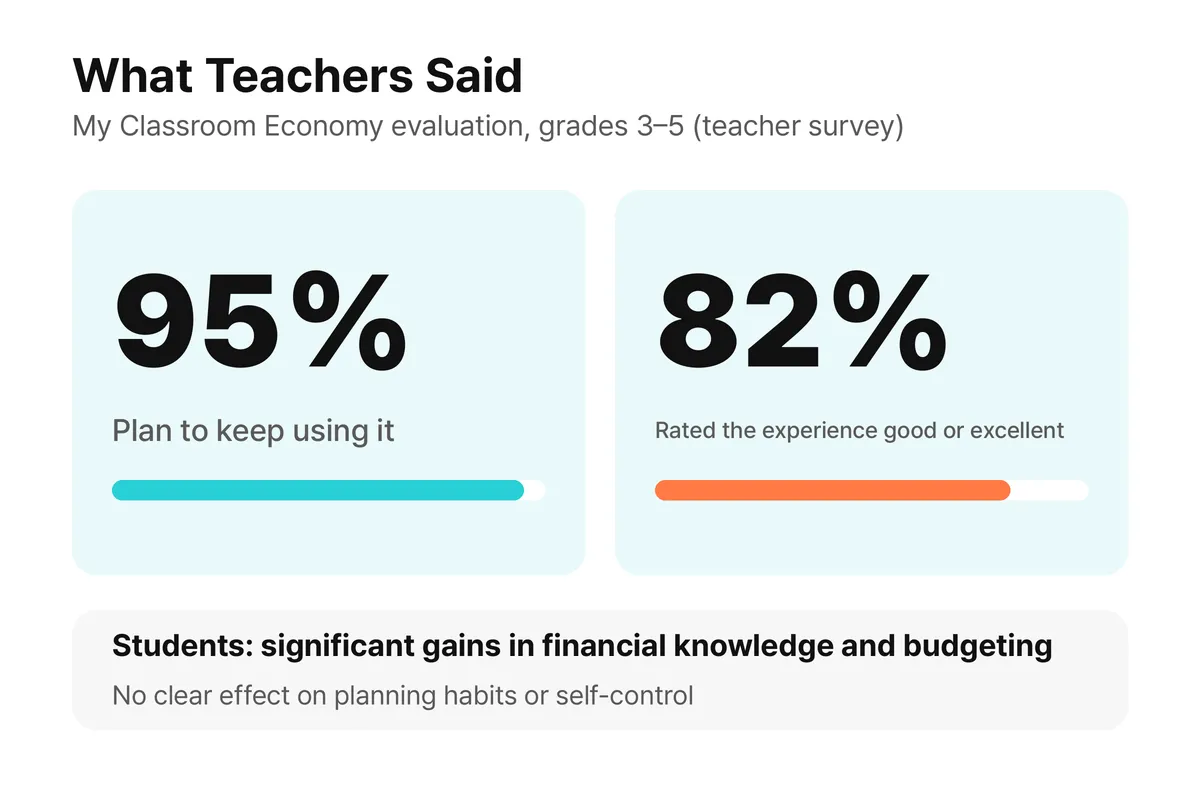
Ninety-five percent of participating teachers said they plan to keep using the program, and 82% rated their experience as good or excellent. Teacher satisfaction was high as well.
5 steps to running a classroom economy
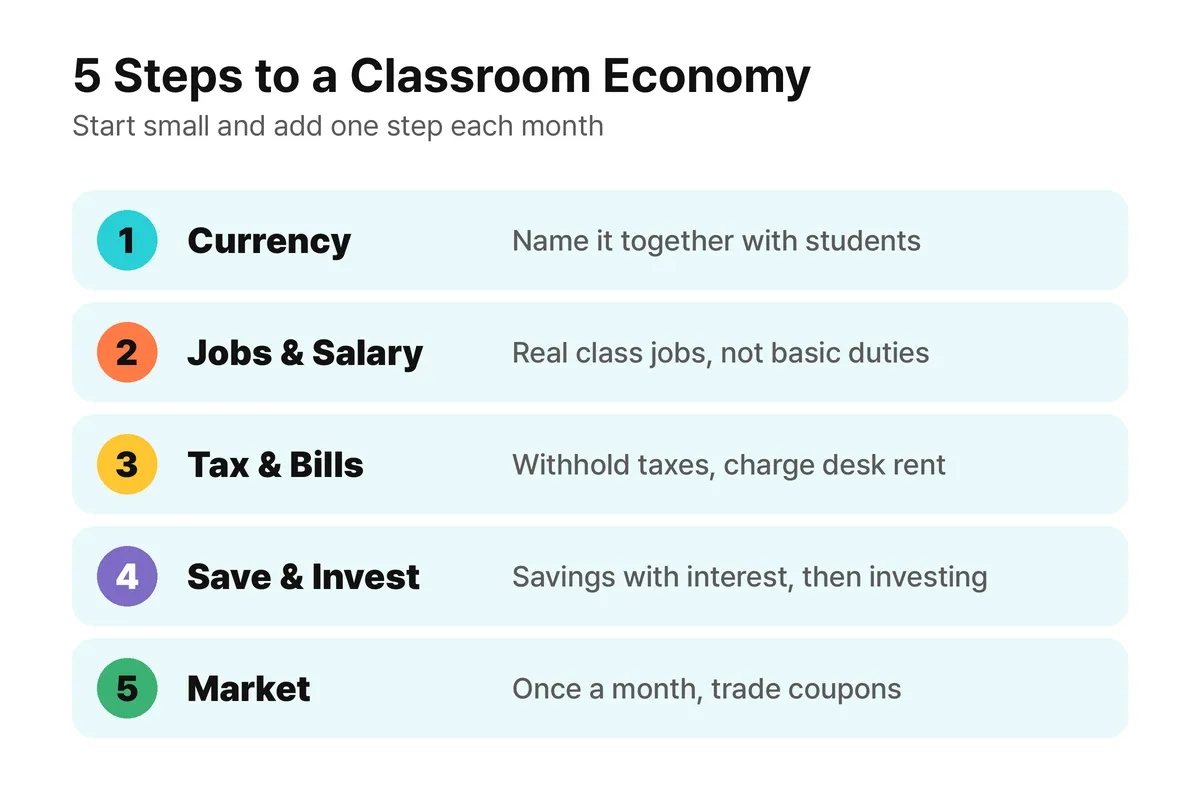
Step 1. Choose your currency Decide on the currency's name and unit together with your students. When students name it themselves, they come to see the system as their class's own. Tracking balances in bank logs instead of handing out paper bills also means no lost money to worry about.
Step 2. Set up jobs and salaries Turn real classroom tasks, such as handing out milk, cleaning the board, or managing the class bank, into jobs, and set a salary for each. It's best not to pay students for basic responsibilities like homework or class participation. Paying for what students should already be doing can make those tasks feel optional whenever no money is attached.
Sample class jobs
Job | What they do | Related concept |
|---|---|---|
Banker | Checks classmates' bank logs, calculates interest | Saving, interest |
Tax collector | Withholds taxes from salaries, keeps the tax ledger | Taxes, public finance |
Statistician | Summarizes last month's market transactions | Organizing data, prices |
Environment monitor | Handles recycling and keeps the classroom tidy | Public services |
Credit rater | Assigns credit scores based on income and spending records | Credit |
Match the number of jobs to your class size, and rotate jobs every month so students can try different roles. Setting different salaries for different jobs gives you a natural opening to discuss why some work pays more.
Step 3. Set taxes and expenses Withhold taxes from salaries and set regular expenses, such as desk rent. When students see their tax money being spent on class events or shared supplies, they come to understand what taxes are for.
Step 4. Open saving and investing Offer a savings account that pays interest when students leave their money in for a set period. Once students are comfortable with it, add an investment option whose value rises and falls, so they can feel the difference between saving and investing.
Step 5. Open a market Hold a market once a month where students buy and sell coupons or small items. Deciding what to buy teaches students to make choices within their budget.
How to start in the first month
Week 1: Choose the currency's name and unit, and make a list of class jobs together.
Week 2: Have students pick jobs and pay the first salary. Practice filling in bank logs.
Week 3: Introduce taxes, and hold a class meeting to decide how to spend the tax money.
Week 4: Hold the first market, and look back on what students earned and spent during the month.
Saving and investing can wait until the second month. Once students settle into the system, some may even ask, "When can we start saving?"
Adjusting by grade level
Grades 3–4: Stick to jobs, salaries, and the market. Use small amounts so the math stays within addition and subtraction.
Grades 5–6: Add taxes, saving, and investing step by step. Having students calculate interest as a percentage connects the activity to math class.
Middle school: Let students set tax or interest rates in class meetings, and have them debate how a policy change affects the class economy.
Let parents know in advance
Sending a letter home explaining the purpose before you start helps avoid misunderstandings. Explain that the currency exists only in the classroom and has no connection to real money or purchases, and that the goal is not to collect as much money as possible but to practice making choices and reflecting on them. If you invite families to ask their child what they bought or saved in class that day, the classroom economy can carry over into conversations at home.
What to watch out for
Don't do everything at once: Start with jobs and salaries, then add taxes, saving, and investing one per month.
Don't use fines as punishment: If fines pile up, the classroom economy turns into a behavior management tool. Save fines for the few rules that truly need them.
Watch for gaps: Large differences in balances can discourage some students. Avoid posting rankings, and consider resetting the system each semester.
Connect it to record-keeping: Having students record their salaries and spending on an allowance tracker worksheet adds a layer of reflection to the classroom economy.
Summary
The goal of a classroom economy is not to teach students how to make money, but to give them a full year of experience working, sharing, and making choices. Start small and add rules together with your students, and your classroom can become the closest economics textbook they have.
Katsby creates English financial and economic education for upper elementary and middle school students. If you'd like to go deeper into the investing stage of a classroom economy, see our guide to running a mock investing class.
This blog is run by Katsby, which creates English financial and economic education for teens.