What Is a Mock Investing Class? A Guide for Elementary and Middle School Teachers
What is a mock investing class? Learn a 4-step way to run one in a 40-minute lesson, how to adjust it by grade level, and what to watch out for in elementary and middle school.

Haru ParkHead of Growth & Partnerships

More students are talking about stocks in the classroom these days.
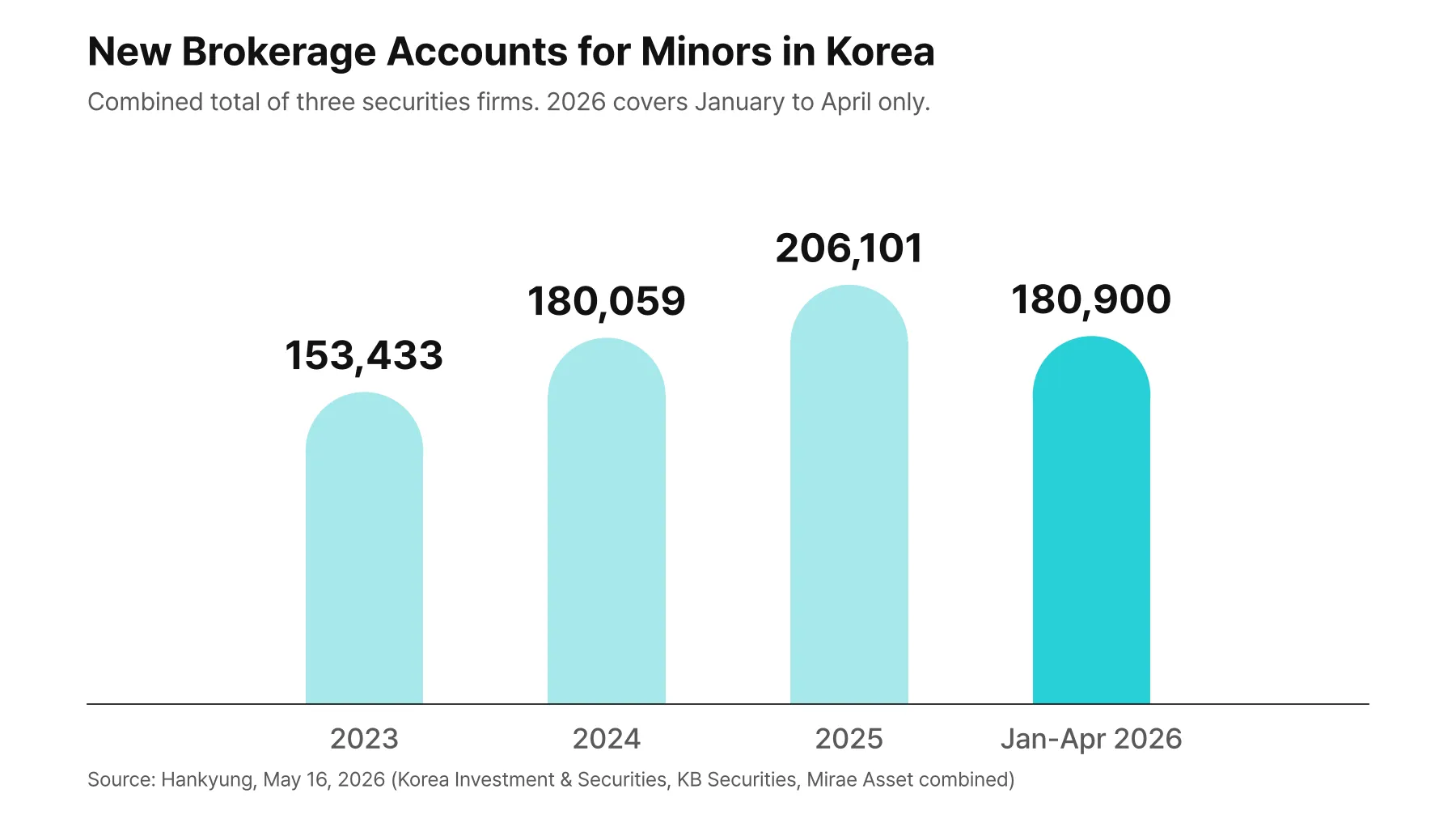
In fact, three major Korean securities firms opened 180,900 new accounts for minors from January to April 2026, nearly matching the 206,101 opened in all of 2025.
So how can schools turn this interest into learning? One answer is a mock investing class. In this article, we look at what a mock investing class is, how to run one in elementary and middle school classrooms, and what to watch out for.
What is a mock investing class?
In a mock investing class, students make investment decisions with virtual money instead of real money. They read information about companies and markets, decide on their own which companies to invest in and how much, and then check the results.
What matters is the decision-making process, not the returns.
As students look back on why they chose a company, what information shaped their decision, and what they missed when the results differed from their expectations, they naturally learn how to read economic news and how risk and return are connected.
Why run mock investing in elementary and middle school?
As we saw in our article on the U.S. financial education mandate, 70% of U.S. teens aged 13 to 17 said they are interested in investing. In Korea, too, students are encountering investing at a younger age.
If students only learn about investing from friends showing off gains or from short videos, they can easily come to see it as a matter of luck or one big win. A mock investing class matters because it lets students first experience investing as a matter of information and judgment, without the risk of real losses.
Mock investing programs for elementary students are also being offered outside school. For example, Ulsan's Dong-gu district ran a financial education program in July 2026 where students in grades 4 to 6 read the news and then tried mock investing.
How to run a mock investing class in elementary and middle school
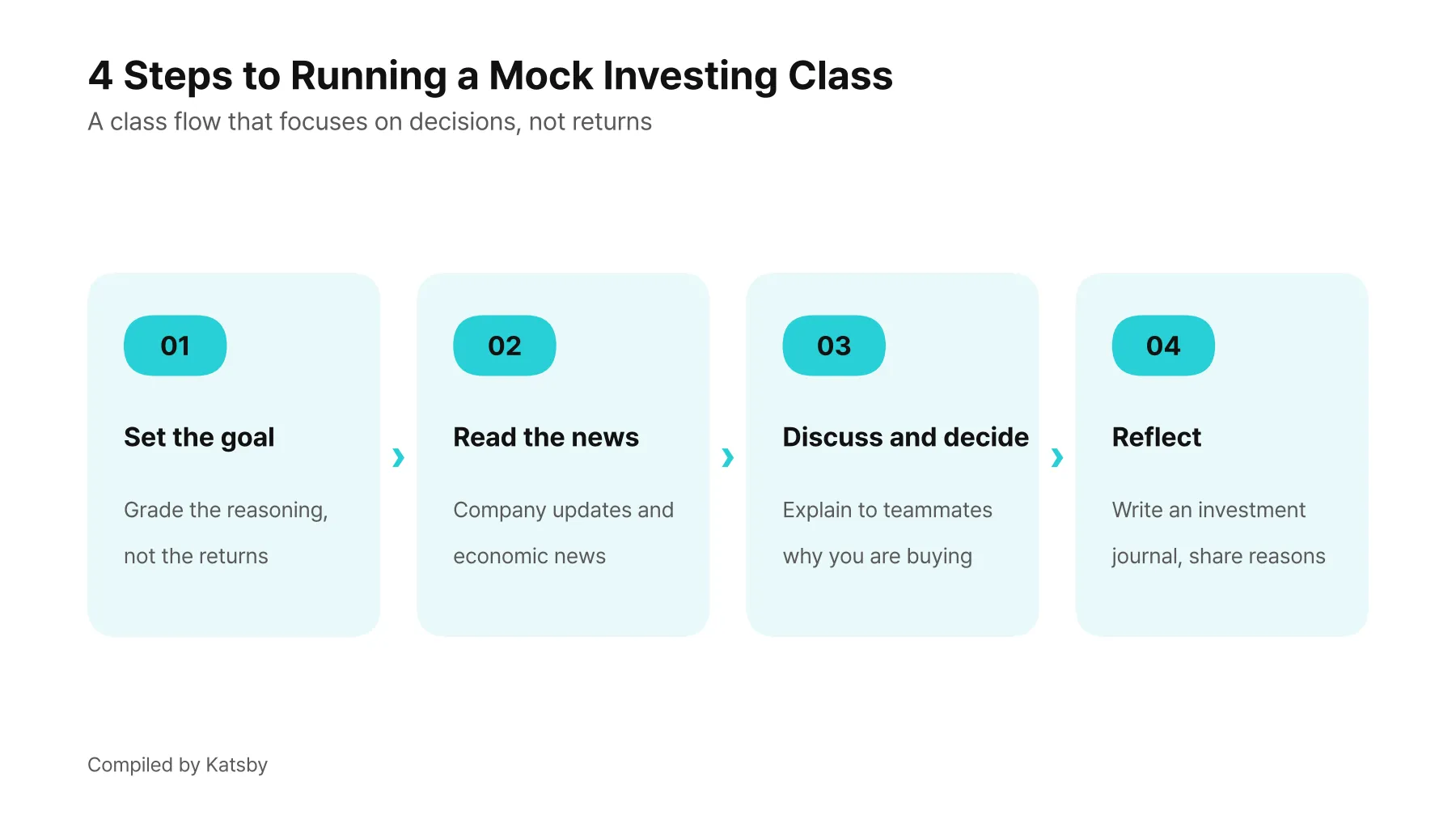
Step 1. Set the goal
Before the class begins, make it clear that this is not a class where the team that earns the most wins. When you grade the reasoning behind decisions rather than the returns, students approach the activity differently.
Step 2. Read the news
Have students read company updates or economic news before making investment decisions. With upper elementary students, start with one or two short articles. With middle school students, it helps to give both positive and negative news about the same company.
Step 3. Discuss and decide
Working in teams rather than alone gives students a chance to hear each other's reasoning and persuade one another. The key is to have students explain to their teammates why they want to buy, not just what.
Step 4. Reflect
After checking the results, have students write an investment journal. Simply noting what information they used and how the results differed from their expectations keeps the class from ending as just a game and turns it into learning.
Sample 40-minute lesson
Here is one way to fit all four steps into a single 40-minute lesson.
Time | Activity |
|---|---|
5 min | Explain goals and rules, hand out virtual money |
10 min | Read company updates and economic news |
15 min | Team discussion and investment decisions |
5 min | Check results |
5 min | Write investment journals, each team shares its reasoning |
Start with a single lesson. Once students are comfortable, you can expand over several lessons, having them follow news about the same companies and adjust their investment decisions.
Adjusting by grade level
Upper elementary: Choose companies students already know (food, games, toys, and so on) and limit each round to three or four companies. Simple questions like "Is this news good or bad for the company?" help students focus on making a judgment.
Middle school: Add more companies and have students compare competitors in the same industry. Comparing the results of spreading investments across companies with putting everything into one company lets students see the link between risk and return for themselves.
What to watch out for
Keep competition over returns in check: Leaderboards make the class more exciting, but rewarding returns alone tends to encourage all-in bets with no reasoning behind them. Reward teams that explain their reasoning well, too.
Treat losses as learning: Having teams that lost money share what they learned helps students see losses as experience rather than failure.
Separate virtual from real: Let students and parents know that this is a learning activity using virtual money, so the class is not mistaken for encouragement to invest real money.
Check devices in advance: Programs support different devices (PCs, tablets, Chromebooks), so confirm before class.
5 things to check when choosing a mock investing program
If creating every material yourself is too much, you can use a ready-made program. When choosing one, check these five things first.
Grade level: Does the recommended age range include your students?
Class time: Can it be completed within one lesson (40 to 45 minutes)?
Devices: Can students join using the devices your school has (PCs, tablets, Chromebooks)?
Cost and sign-up: Is it free? Does it require booking or registration?
Follow-up activities: Does it include reflection or writing activities after class?
Wrap-up
The goal of a mock investing class is not to learn how to make money, but to learn how to read information and make decisions. When the class centers on reasoning over returns and reflection over results, it can be meaningful financial education even in elementary and middle school.
You don’t need to plan a whole unit to get started. Three or four companies your students already know, one or two short articles, and an investment journal are enough to try it in your next class. If your students start talking about why they made a decision before how much they earned, the class is already doing its job.
This blog is run by Katsby, which creates English financial and economic education for teens.