Financial Literacy at International Schools: How IB, British, and American Schools Teach Finance
How do international schools teach financial literacy? Compare IB units of inquiry, England's citizenship curriculum, and U.S. national standards, plus tips for the classroom.

Eve NamGrowth Marketer
Where and when do international school students learn about finance?
Local schools in Korea follow the national curriculum, but international schools follow different curricula, such as IB, British, or American. As a result, financial literacy at international schools varies quite a bit in when and how it is taught, depending on the curriculum. Even in the same grade, students at one school may be learning to make a budget, while another school may not cover finance as a separate topic at all.
Why look at financial literacy at international schools?
International schools run IB, British, and American curricula as they are. The IB alone is offered at more than 6,200 schools in over 160 countries. This makes international schools a close-up view of when and how schools abroad teach financial literacy.
Source: International Baccalaureate, Facts and figures (May 2026)
Around the world, financial literacy is quickly becoming a core part of school education. England plans to extend financial education into the primary curriculum from 2028, and 30 U.S. states now require it for high school graduation. For teachers and education officials designing financial literacy programs, these curricula offer a useful reference point. For parents considering an international school, they show differences worth looking at when choosing a school.
The international schools series
The Katsby blog is publishing a three-part series on international schools.
International Schools in Asia: School Counts and Growth by Country
Financial Literacy at International Schools: How IB, British, and American Schools Teach Finance (this article)
Financial Literacy Lesson Plans for International Schools: 40-Minute Lessons by Grade (coming next week)
Financial literacy by curriculum at a glance
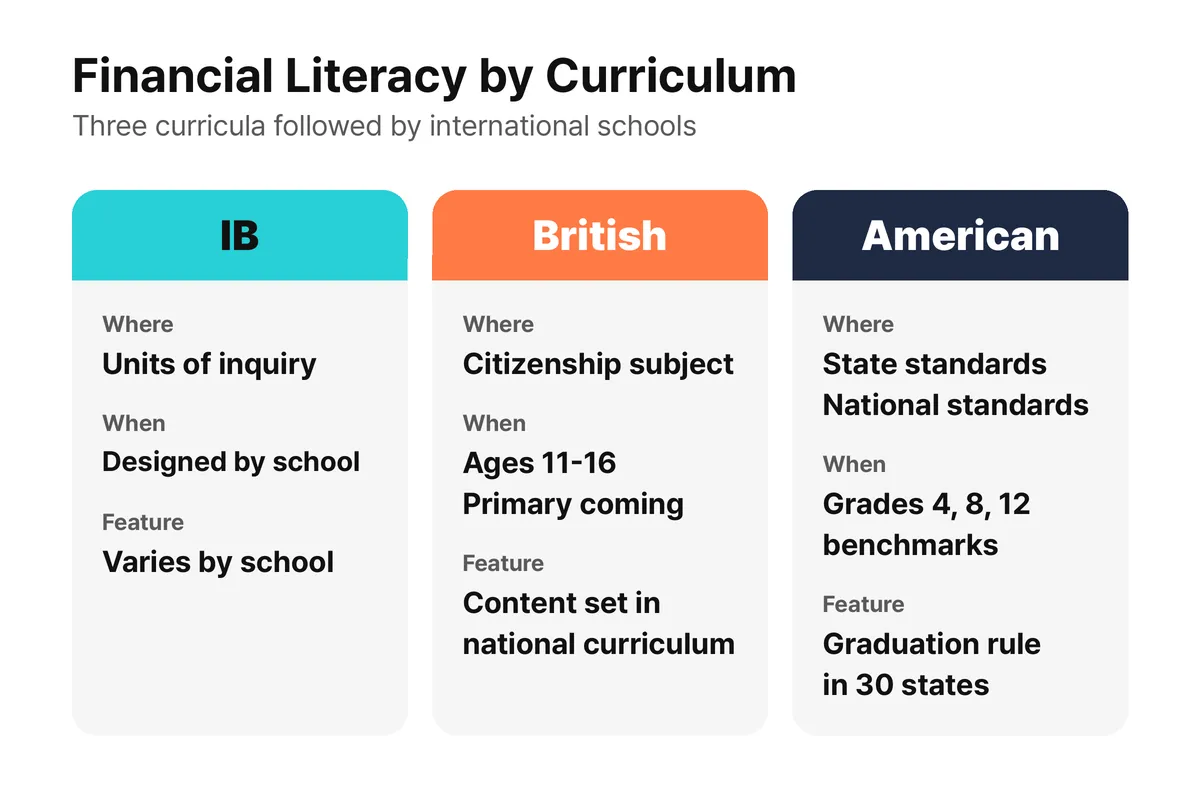
IB | British | American | |
|---|---|---|---|
Where it's taught | As a theme within units of inquiry | Citizenship subject | State standards and national personal finance standards |
When it's mainly taught | Designed by each school | Ages 11–16 (expanding to primary) | Step by step by grade (benchmarks for grades 4, 8, and 12) |
Key feature | Unit design varies by school | Content is set out in the national curriculum | Expanding as a high school graduation requirement |
All three curricula cover financial literacy, but they differ in how specifically the content is defined.
IB: Units of inquiry, not a set subject
The IB has no separate financial literacy subject. Instead, its primary programme, the PYP (ages 3–12), builds learning around six transdisciplinary themes, and many schools run units of inquiry on economic activity or money under the theme "How we organize ourselves."
For example, one IB school in India ran an "Economic activities" unit under this theme, where students helped decide how their work would be assessed and gave feedback on each other's work.
Because IB schools design their own programme of inquiry, how deeply finance is covered depends on the choices of each school and teacher.
Source: IB Blogs, Sharing PYP
British: Financial literacy set out in the citizenship subject
Since 2014, England has included financial education in the citizenship subject of its national curriculum.
KS3 (ages 11–14): The functions and uses of money, budgeting, and managing risk
KS4 (ages 14–16): Income and expenditure, credit and debt, insurance, savings and pensions, financial products, and public finance
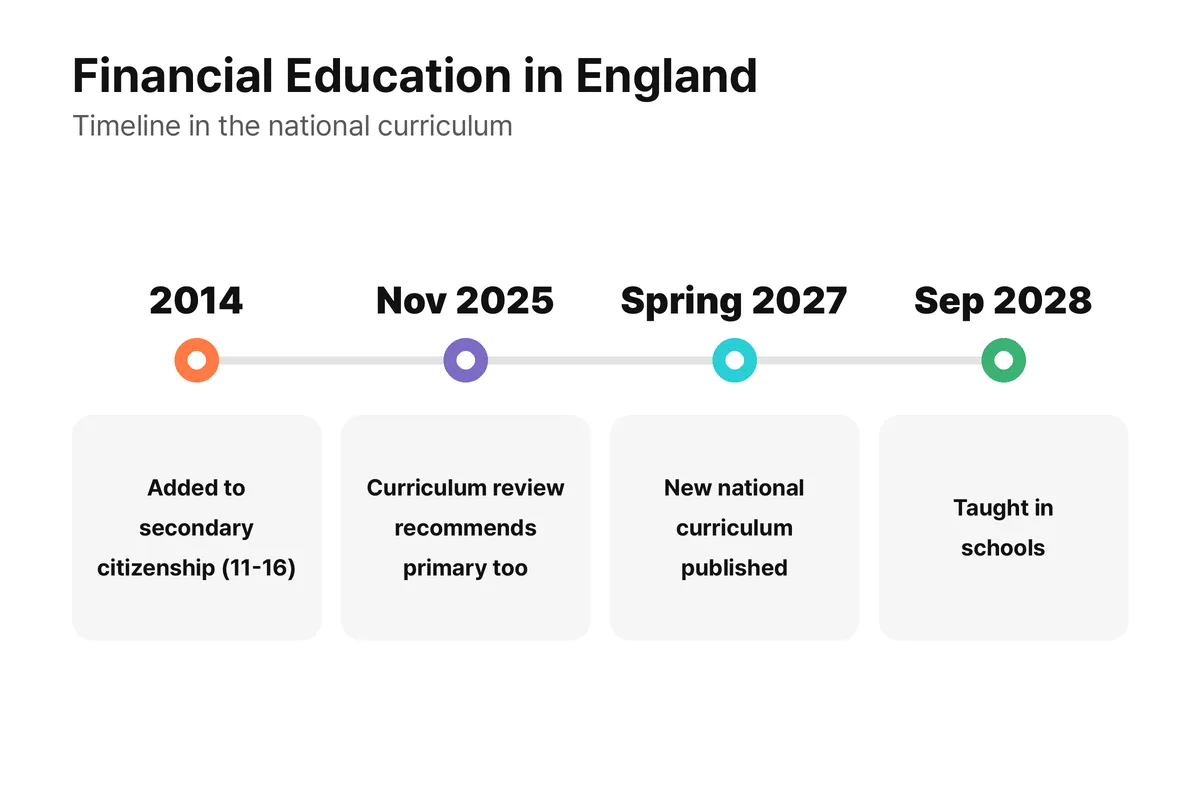
Changes are also on the way. The final report of the Curriculum and Assessment Review, published in November 2025, recommended adding financial education to the primary curriculum for the first time and teaching financial maths in secondary maths. The new national curriculum is expected to be published in spring 2027 and taught in schools from September 2028. Currently, academies in England do not have to follow the national curriculum, but this is set to change so that all state schools, including academies, will follow it.
British international schools overseas are not required to follow England's national curriculum, but many use it as the basis for their own curriculum, so primary financial education is likely to grow at these schools as well.
American: National standards and state requirements
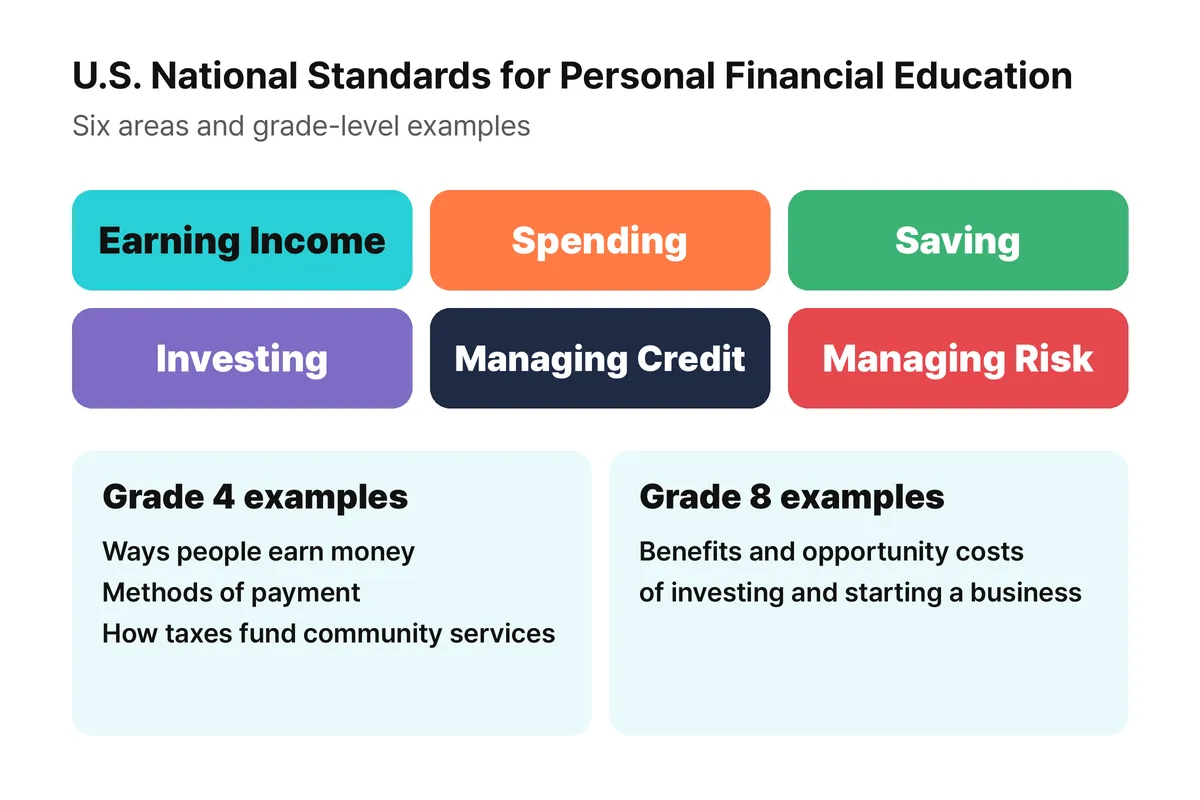
The U.S. has no single national curriculum. Instead, the National Standards for Personal Financial Education (2021), developed by the Council for Economic Education (CEE) and the Jump$tart Coalition, serve as a reference for many states and schools.
These standards divide financial literacy into six areas: earning income, spending, saving, investing, managing credit, and managing risk. They set goals for students to reach by grades 4, 8, and 12. In grade 4, students learn the different ways people earn money, methods of payment, and how taxes fund community services. In grade 8, they learn the benefits and opportunity costs of investing and starting a business.
At the high school level, the number of states requiring a personal finance course for graduation has grown to 30. You can read more in our article on financial education requirements in the U.S.
What to keep in mind when teaching financial literacy at an international school
Connect to existing units instead of adding a new subject: All three curricula teach financial literacy within other subjects or units. Linking finance topics to lessons you already teach, such as percentages in maths, economics units in social studies, or citizenship, keeps the workload manageable.
Consider different currencies and systems: International schools bring together students of many nationalities. Since taxes and banking systems vary by country, it works best to build lessons around concepts that apply everywhere, such as income, spending, and saving.
Support English financial vocabulary: For students whose first language is not English, starting with basic words like save, spend, and budget helps them grasp the concepts faster. You can find activity ideas in our guide to financial literacy in English class.
Make time for reflection: As in IB inquiry learning, it helps to give students time after a finance activity to reflect on why they made their choices. Explaining their own decisions stays with students longer than getting the right answer.
Use grade-level benchmarks as a guide: The grade 4 and grade 8 goals in the U.S. standards are a useful reference for setting lesson levels by grade, whatever curriculum your school follows.
Where to start by grade level
Even across different curricula, the topics that suit each grade level are similar. If you're just starting financial literacy at an international school, try following this order.
Lower primary (up to grade 3): Students learn to tell needs from wants and understand that buying things takes money. Short activities, like sorting picture cards, work well.
Upper primary (grades 4–5): Cover ways to earn money, taxes, and why saving matters. Starting with an allowance tracker worksheet, where students record a week of money in and money out, connects naturally to the grade 4 goals in the U.S. standards.
Middle school (grades 6–8, British KS3): Cover budgeting, managing risk, and investing and opportunity cost. A mock investing class, where students pick companies with virtual money and reflect on the results, fits well with the goals for this age.
At any grade, repeating short activities several times helps students learn the concepts better than a single one-off lesson.
Summary
Financial literacy at international schools looks different depending on the curriculum. IB covers finance within units of inquiry designed by each school, British schools through the citizenship subject, and American schools through national standards and state requirements. What they have in common is that finance is taught not in isolation, but connected to students' lives and other subjects. If you're preparing to teach financial literacy at an international school, start by finding where finance fits within your school's curriculum. Next week, in the final article of this series, we'll turn these ideas into 40-minute lesson plans by grade.
Katsby creates English financial and economic education for upper elementary and middle school students.
This blog is run by Katsby, which creates English financial and economic education for teens.